Custom Home Building & Remodeling
Smart Homes Are Going Mainstream. Here's What That Means for Your Altadena Build.
Smart home technology is becoming standard in high-end construction. Here's how Altadena homeowners can build it in from the start.
The Short Version
A new global report projects the smart home market to pass $479 billion by 2030, and for Altadena homeowners planning a custom home, rebuild, or renovation, the smartest move is wiring for that technology before the walls go up.
If you've been assuming smart home features are still a luxury niche, the numbers say otherwise. On October 28, The Business Research Company released its Smart Home Global Market Report 2026, and the headline figure is hard to ignore: the global smart home market is projected to surpass $479 billion by 2030, growing at a compound annual rate of 22%. What used to be a novelty for tech enthusiasts has become something mainstream buyers simply expect, especially in high-end homes. If you're planning a custom home, a complete rebuild, or a whole-home renovation in Altadena, this shift matters to you, and the best time to act on it is before a single wall is closed.
The Numbers Behind the Shift
The report forecasts the smart home market from 2026 through 2035, and the trajectory is steep. Within the broader electrical and electronics industry, which is projected to reach $5,579 billion by 2030, smart home solutions will account for nearly 9% of total value. Asia-Pacific is growing fastest, expected to climb from $53 billion in 2025 to $172 billion by 2030, but the United States remains one of the largest and most established markets in the world. The report identifies three main forces behind the growth: home automation and IoT devices (contributing roughly 1.5% annual growth), energy efficiency and sustainable living initiatives (about 1.0%), and home security with remote monitoring (about 0.8%). None of these are fads. They're responses to how people actually live now: they want to control the house from their phone, cut their energy bills, and check the front door from the office.
Security Is the Biggest Slice of the Pie
Here's the detail that should interest any Altadena homeowner planning a major project. According to market insights cited alongside the report, security and access control is on track to be the dominant smart home segment by 2030, accounting for about 27% of the market, or roughly $130 billion. That's driven by smart locks, video doorbells, connected surveillance cameras, and advances in facial recognition and video analytics. In plain terms: the technology most homeowners want most is the kind that needs to be planned into a house, not bolted onto it. Camera placement, doorbell wiring, keypad locations, and network coverage all work better when they're decided during construction, when walls are open and changes are cheap. Retrofitting means fishing wires through finished drywall, patching, repainting, and settling for camera angles that were never part of the original design.
Why This Matters Most During a Build or Renovation
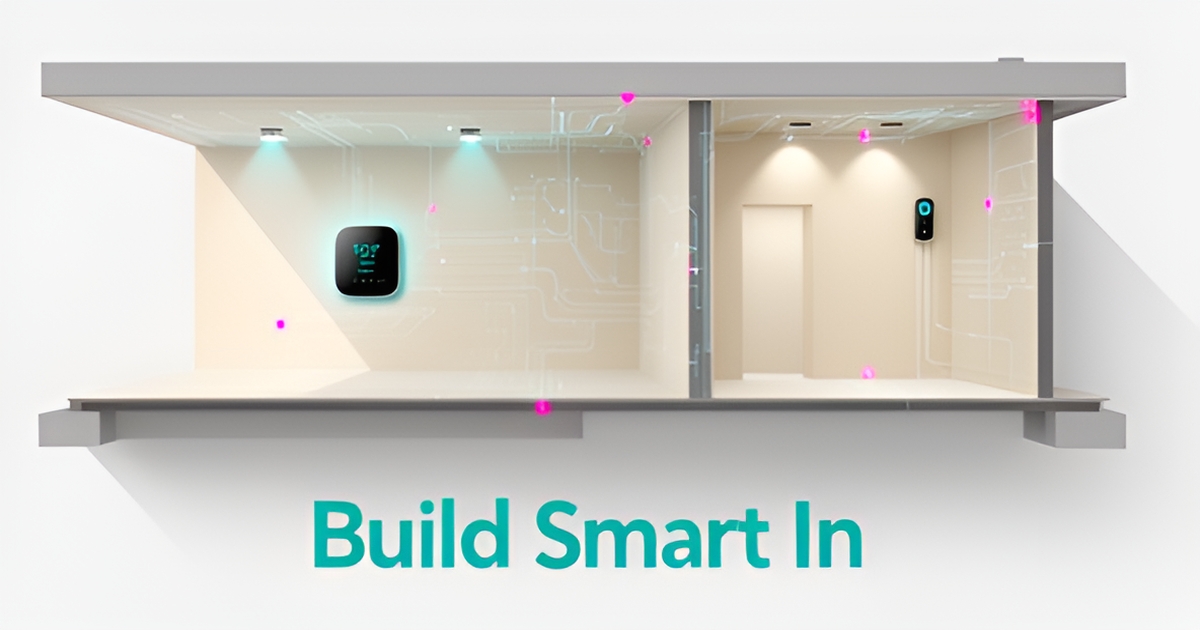
There's a practical difference between adding a smart speaker to a finished house and building a smart-ready home from the start. During a ground-up build or a whole-home renovation, you have a window that never comes again: every wall is accessible, every ceiling is open, and the cost of running wire, placing a strong network backbone, and roughing in for future devices is a fraction of what it costs later. Smart thermostats, automated lighting, connected appliances, and climate controls all depend on the same fundamentals: reliable power, good network reach, and sensible device locations. The report notes that improved device interoperability, meaning devices from different manufacturers working together through centralized apps, has been a major driver of adoption. That's good news for homeowners, but it only pays off if the infrastructure underneath is right. This is exactly the kind of thing that belongs in pre-construction planning, when scope, budget strategy, and design-team coordination are being worked out, rather than in the final month of a project when the options are limited.
Energy Efficiency Pays for Itself
The second big growth driver is energy efficiency, and it's the one with a direct financial payoff. Smart thermostats, automated lighting controls, and energy monitoring devices give homeowners real-time feedback on consumption, which changes behavior and lowers bills. The report points to government incentives, stricter efficiency regulations, and rising energy costs as the catalysts here. For a high-end custom home or a full renovation in Altadena, that argues for building the efficiency layer in deliberately: proper insulation, efficient HVAC design, and the wiring and sensors that let a smart system actually manage the house well. Done right, the technology doesn't just add convenience. It lowers the monthly cost of owning the home for as long as you own it.
What We Recommend to Altadena Homeowners
At JMB Builders, we build exclusively in Altadena, and we approach every project as one community with one standard. Our process runs through six stages, starting with an initial conversation about your project and goals, moving into discovery and feasibility, then pre-construction planning, permitting and preparation, construction management, and finally completion and closeout. Smart home readiness fits naturally into the early stages. When we sit down with a homeowner planning a custom home, a rebuild, a whole-home renovation, or an ADU, we want to hear about technology goals early, even if they're vague. You don't need to know which brand of lock or thermostat you'll use in three years. You just need a builder who will plan the pathways, power, and network backbone so those decisions stay open and inexpensive. We're licensed, bonded, and insured (CSLB License #1103479), with $2,000,000 in general liability coverage and a $100,000 contractor bond on file, and we coordinate with your design team so the technology layer is part of the plan rather than an afterthought.
Key Points
- The Business Research Company's Smart Home Global Market Report 2026, released October 28, projects the market to exceed $479 billion by 2030, growing at a 22% annual rate.
- Security and access control is expected to be the largest product segment by 2030, at roughly 27% of the market, or about $130 billion.
- Energy efficiency tools like smart thermostats and automated lighting are among the top growth drivers, helped by rising energy costs and government incentives.
- Retrofitting smart technology after construction costs more and delivers worse results than planning for it during the build.
- Homeowners planning a ground-up home, rebuild, whole-home renovation, or ADU in Altadena should raise technology goals early, during discovery and pre-construction planning.
The smart home market's climb toward $479 billion tells you where homeowner expectations are headed: technology integrated into the house itself, led by security and energy efficiency. If you own a lot or a home in Altadena and you're planning a ground-up custom home, a complete rebuild, a whole-home renovation, or an ADU, the smartest version of that project is one that's smart-ready from day one. That conversation costs nothing and commits you to nothing. Call us at (310) 491-6878 to schedule a project consultation, and we'll talk honestly about your goals, your property, and whether we're the right fit for each other.