Custom Home Building & Remodeling
What the Tonia Homes Completion Means for Altadena Homeowners Still Deciding About Rebuilding
Altadena's Tonia Homes were permitted in four weeks and built in six months. Here's what the project's approach means for homeowners planning a rebuild, renovation, or ADU.
The Short Version
The completed Tonia Homes demonstration project in Altadena shows how coordinated design, permitting, and construction can compress rebuild timelines, and it offers practical lessons for any local homeowner planning a rebuild, renovation, or ADU.
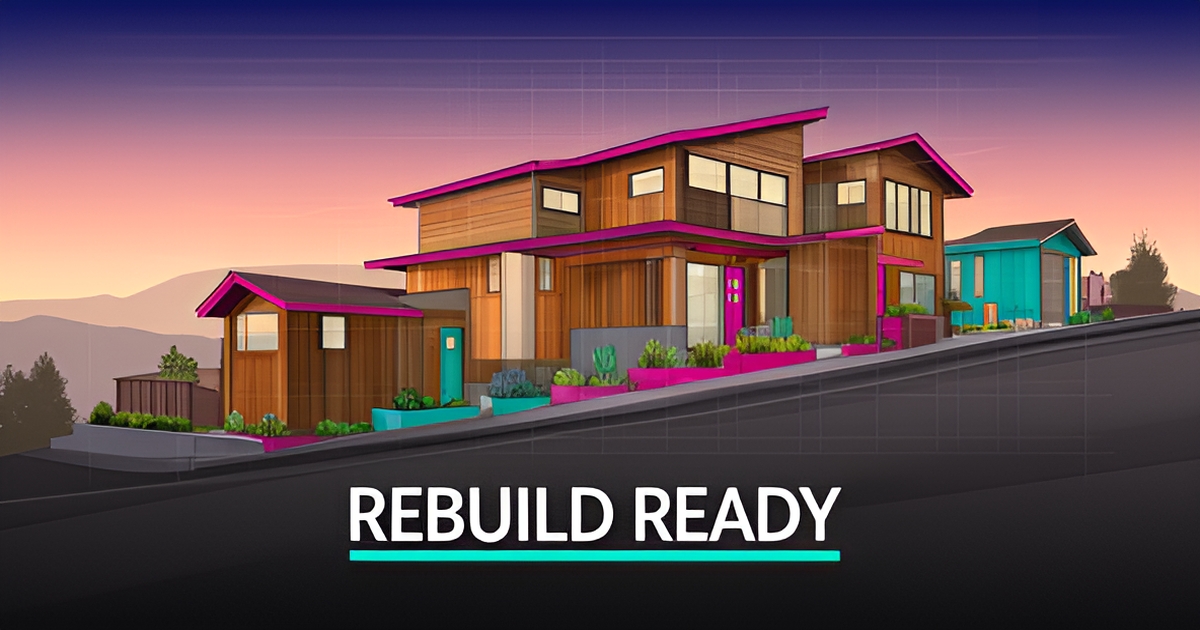
Last Saturday, nearly 400 people gathered in Altadena to celebrate the completion of the Tonia Homes, two fully furnished demonstration homes, each with its own ADU. The event, held October 25, drew rebuilding families, community partners, and officials including U.S. Rep. Judy Chu, State Senator Sasha Renée Pérez, and L.A. County Supervisor Kathryn Barger. For a community still working through the aftermath of the January 2025 Eaton Fire, the moment carried real weight. These homes were permitted in about four weeks and finished for occupancy in roughly six months, landscaping included. That's a compressed timeline by almost any standard, and it happened because of how the project was organized, not because anyone cut corners. If you own a lot or a damaged home in Altadena and you're still weighing your options, there's a lot here worth understanding.
What Actually Got Built, and What It Cost
The Tonia Homes were a partnership between the Foothill Catalog Foundation, a nonprofit that maintains pre-approved architectural designs, and Williams Rebuild, the construction firm on the project. Support came from the Callahan Family Foundation and the Greenline Housing Foundation. Each property came in at roughly $1.35 million all-in, covering land acquisition and every development and construction cost. The estimated market value sits closer to $1.85 million per property. That gap isn't an accounting trick. It reflects a not-for-profit model: waived builder profit, discounted and donated labor, and materials and services provided below market rates. The homes will be offered to fire-impacted families at cost. The most memorable moment of the celebration came when longtime residents Erion and Stephan Taylor learned their family will receive the completed "Elizabeth" home and its ADU at cost, roughly $500,000 below market value.
The Design Catalog Is Changing How People Start
Here's the part I'd urge any Altadena homeowner to pay attention to. The Foothill Catalog Foundation maintains more than 70 pre-approved architectural designs inspired by the look and feel of Altadena's neighborhoods. According to the project's organizers, choosing a pre-approved design can save a homeowner over $100,000 in preconstruction costs and shave years off the front end of the process compared with commissioning fully custom architecture. That's a big deal for families who have been stuck in limbo, and it changes the kind of conversation you should be having with a builder. If you arrive with a catalog plan in hand, a lot of the design work is already settled, and the conversation shifts immediately to feasibility, budget strategy, and construction sequencing. That's a different starting point, and honestly, a more efficient one for many families. It's also not the right answer for everyone. Homeowners who want a home designed around how their specific family lives, or who have a lot with unusual constraints, may find catalog plans too limiting. Both paths are legitimate. The mistake is assuming one size fits all.
Where the Speed Actually Came From
The four-week permit and six-month build numbers will get a lot of attention, and they should. But it's worth being precise about what produced them. Williams Rebuild used an integrated model where estimating, procurement, permitting, and construction were aligned from day one. Design decisions, material ordering, and site work were sequenced deliberately rather than discovered mid-project. In my experience, this is where speed is won or lost. A fast build isn't built fast. It's planned thoroughly enough that the build phase has nothing left to argue about. Every permit situation is different, every lot is different, and no responsible builder will promise you a timeline before understanding your property and your scope. What a project like this proves is that when discovery, planning, and permitting are handled with real discipline up front, dramatic timelines are achievable. Treat the six-month benchmark as evidence of what good preparation makes possible, not as a quote for your project.
Why Every Rebuild Conversation Now Includes an ADU
Both Tonia demonstration homes included an ADU. That wasn't incidental. In post-fire Altadena, ADUs have become a standard feature of rebuild plans, and for good reasons. A detached ADU can house multi-generational family members during and after a rebuild. It can generate rental income that helps offset construction and carrying costs. It adds long-term flexibility to a property that a single main house doesn't. If you're planning a ground-up home, a complete rebuild, or even a major renovation on an Altadena lot, you should at least run the ADU numbers before finalizing your design. Doing it as part of the original project is far more efficient than adding it later, and the design coordination is much simpler when the main home and ADU are planned together.
The Homes Were a Classroom, and That Matters Too
Since groundbreaking, the Tonia Homes functioned as living community resources. They hosted workshops, construction tours, and hands-on guidance on permitting, materials, design, and resilient building practices. Rebuilding families could walk through a real project and see real decisions, not just renderings. That educational role is easy to overlook, but it addresses the biggest obstacle most families face after a disaster: not cost alone, but overwhelm. Cynthia Sigler, AIA, and Executive Director Alex Athenson of the foundation have been explicit that the goal is removing the barriers that make rebuilding feel impossible, so longtime residents can stay in place. Nearly two years after the Eaton Fire, thousands of Altadena households are still somewhere in the rebuilding pipeline. A proof-of-concept that shows a repeatable pathway, with nonprofits, private builders, and government aligned, is genuinely useful to that population.
How to Apply This to Your Own Project
So what should you take from all this if you own property in Altadena? First, decide your design path early. A catalog plan can save you significant money and time if one of the 70-plus designs fits your lot and your life. If it doesn't, a custom design is worth doing right, and you should budget and plan accordingly. Second, invest real effort in pre-construction work before you expect anything to move quickly. Scope, budget strategy, existing conditions, and design-team coordination are what make the construction phase smooth. Third, evaluate your builder's process, not just their portfolio. Ask how they handle discovery, how they sequence trades, how they communicate during construction, and what their closeout looks like. A six-stage process with clear checkpoints, from the first conversation through walkthroughs and documentation, exists precisely because the projects that go wrong usually go wrong in the gaps between stages. And fourth, think about the ADU question now, not after the main home is designed.
Key Points
- The Tonia Homes, two fully furnished demonstration homes with ADUs in Altadena, were celebrated at a public event on October 25, 2026, drawing nearly 400 attendees.
- The homes were permitted in roughly four weeks and finished for occupancy in about six months, thanks to an integrated planning and construction model.
- The Foothill Catalog Foundation offers more than 70 pre-approved architectural designs, which can reportedly save homeowners over $100,000 in preconstruction costs.
- Every demonstration home included an ADU, reflecting how standard ADUs have become in Altadena rebuild plans.
- Homeowners should treat the six-month benchmark as an example of what thorough pre-construction planning makes possible, not as a guaranteed timeline for their own project.
The Tonia Homes are a milestone for Altadena. They show that character-preserving, attainable rebuilding is possible when design, permitting, and construction are coordinated with discipline, and they've already changed one family's future. If you're an Altadena homeowner planning a ground-up custom home, a complete rebuild, a whole-home renovation, or an ADU, the next step is the same one every successful project starts with: a real conversation about your property, your goals, and whether the fit is right in both directions. That first conversation costs nothing and commits you to nothing. You can reach JMB Builders at (310) 491-6878. We're licensed, bonded, and insured in California (CSLB #1103479), we build only in Altadena, and we'll give you an honest read on your project, whatever stage you're at.